Showing posts with label The Beatles. Show all posts

Saturday, November 20, 2021

1970/71: Two of Us (Special I)

If one special chapter was enough for 1970, so why not three special chapters for 1971? Most of them are Beatles-centered, by the way!

Just in time, springtime!

Paul McCartney recording Rock and Roll Springtime.

Besides the brief hiatus, the activities from the fellow Beatles in music industry never ceased. Ringo Starr released two albums (Beaucoups of Blues and Sentimental Journey, same as our timeline), while Paul began to record his then-debut solo album, as well, as George and John did the same. As a skilled multi-instrumentalist, Paul started recording his solo album alone, alternating between Apple Studios, his home and Morgan Studios.

Despite the official sessions started by June 1970, the desire of recording a solo album comes from as early as 1969 to Paul, in a session that delivered "The Lovely Linda" and "That Would Be Something", which would be later added to The Beatles' Abbey Road. As with much of the album, McCartney sang the composition accompanied by acoustic guitar before filling the remaining tracks with a second guitar part, bass and percussive accompaniment.

As for John, he first reassembled The Dirty Mac minus Keith Richards, who was replaced by longtime friend Klaus Voormann, Eric Clapton who kept in an in-and-out of the group as a member of Derek and the Dominoes, and Mitch Mitchell, former drummer from the now-disbanded Jimi Hendrix Experience. Clapton would be eventually replaced by Hugh McCracken, a consistent session musician between Paul and John's records at the time.

Eventually the sessions were interrupted as the Beatles were returning, and after a few sessions for John's album included Ringo and George. Paul brought three of his tracks, two of which were already known by the rest of the group, Teddy Boy and Junk, and Maybe I'm Amazed. Wild Life was developed after a jam session with the entire band.

The return for the solo albums came after the first session, and it was focused to finish the records, or wait until after the release of All Things Must Pass. "That deadline fucked me, because I had a lot of work to do with 'Let It Down' and Phil [Spector]. Paul and John were the only beneficiaries with this, since they had simpler records, so I needed to wait until March to touch my album again.", George Harrison.

Ringo and Klaus Voorman during The Dirty Mac sessions.

Paul's return to his solo work started with Linda, who suggested to hire a few more musicians to help him to not get too weary recording four albums in a row (this, from Abbey Road to his solo album). Moving to New York, Paul hold auditions to work with musicians, recruiting David Spinozza and Denny Seiwell. When Spinozza became unavailable, McCracken was also hired to help Paul, suggested by Lennon.

"Paul was overwhelmed by his solo album and then by the sessions with the Beatles, so I suggested to hire some people to work with, while he was recording with the band. He would compose the songs, give it to me and the group would rehearsal until he effectively resumed the recording sessions of the album."

-Linda McCartney 

In contrast to Paul, George and John hired Phil Spector as their producer, with Spector focusing more on George's debut album rather than John's, who produced his debut album largely on his own, with a few appearances of Yoko Ono. Mitchell sometimes recalls the behavior of John changing from being upbeat to highly emotional and would discuss his feelings with Ono as they listened to playbacks in the studio control room.

"There were times at those sessions that were fucking unbearable. John would come up screaming and shouting when we were recording the damn track. The things started to get better when Ringo and George came up to the sessions, we chatted a lot there until they had to return with the group. I had my fair share of contribution to Instant Karma!, so I was quite happy to contribute something to the Beatles."

-Mitch Mitchell

Paul and Linda's album was announced along with John's to February 1971, two months before All Things Must Pass. Originally titled just "Suicide", the label preferred to add "(Call It) Suicide" to avoid backlash. Both agreed with Brian Epstein to release the album before February 20th, with Lennon's album being released two days after Rock and Roll Springtime.

Paul and Linda McCartney – Rock and Roll Springtime

Paul and Linda McCartney - Rock and Roll Springtime (1971)
Genre: Indie pop, folk rock, lo-fi
Total: 40:33
All songs written by Paul McCartney, except when mentioned.

Side A - 19:17
1. "Smile Away" - 3:51
2. "The Lovely Linda" - 0:43
3. "Long Haired Lady" (Paul and Linda McCartney) - 5:54
4. "Hot as Sun/Glasses" - 1:57
5. "(Call It) Suicide" - 2:48
6. "Momma Miss America" - 4:04

Side B - 21:16
7. "Eat at Home" (P. & L. McCartney) - 3:18
8. "Man We Was Lonely" - 2:56
9. "Every Night" - 2:31
10. "Heart of the Country" (P. & L. McCartney) - 2:21
11. "Monkberry Moon Delight" (P. & L. McCartney) - 5:21
12. "Uncle Albert/Admiral Halsey" (P. & L. McCartney) - 4:49

Rock and Roll Springtime is the debut studio album by the husband-and-wife music duo Paul and Linda McCartney. The album was released on 17 February 1971 by Apple Records, with production credited to the duo. It is the first side-project of Paul McCartney outside the Beatles. Similarly to John Lennon/The Dirty Mac and Ringo Starr's Sentimental Journey, it was also recorded in-between the All Things Must Pass sessions. The photos of the cover were taken and arranged by Linda and Paul themselves.

Originally conceived as Paul's original debut album, Linda's inclusion came after the sessions for the album resumed after reuniting with the Beatles during the All Things Must Pass sessions, with Linda contributing and receiving credits afterwards. The first sessions happened with Paul alone, expanding to a number of session musicians in the songs credited to both Paul and Linda.

At the time, the album received negative to mixed reviews, despite being highly anticipated with The Dirty Mac. The album was harshly criticized being called 'half-baked', despite Paul's solo hit with Uncle Albert/Admiral Halsey, which received considerable airplay in the radio. Despite the critics, Paul album reached number 5 in the United States and number 3 in the United Kingdom.

In more recent years, reviews of Rock and Roll Springtime have been more favorable towards the record. The album was considered a crucial mark for DIY musicians, home recordings and lo-fi music styles, gaining a cult following with its successor, Another Day. It is praised by artists such as Neil Young, and even John's son Sean.

John Lennon – John Lennon/The Dirty Mac

John Lennon - John Lennon/The Dirty Mac (1971)
Genre: Rock, avant-pop
Total: 42:05
All songs written by John Lennon.

Side A - 21:47
1.
"Power to the People" - 3:22
2. "Cold Turkey" - 5:01
3. "Well Well Well" - 5:59
4. "I Found Out" - 3:37
5. "Working Class Hero" - 3:48

Side B - 20:18
6.
"Mother" - 5:34
7. "Hold On" - 1:52
8. "God" - 4:09
9. "Love" - 3:21
10. "Remember" - 4:33
11. "My Mummy's Dead" - 0:49

John Lennon/The Dirty Mac, sometimes simplified to just The Dirty Mac is John Lennon's debut album backed by The Dirty Mac. It was released on 19 February 1971 in tandem with the similarly titled album by his wife, Yoko Ono, and two days after Paul and Linda's Rock and Roll Springtime. It was produced by Phil Spector and has a similar cover to Yoko Ono's debut.

To record the album, John Lennon reassembled The Dirty Mac, replacing Keith Richards with Klaus Voorman in the bass, and later Eric Clapton with Hugh McCracken. The sessions for The Dirty Mac happened simultaneously with Rock and Roll Springtime and George Harrison's Let It Down, where a frequent exchange of session musicians happened, while Phil Spector also produced George album. During the same period, John was frequenting a primal scream therapy, which changed his behavior during the sessions.

John's album received mixed reviews, but it was viewed more favorably than Rock and Roll Springtime at the time, being considered "more cohesive" than the other one. "Power to the People" was John's most played track in the radio, as it was released earlier in 1970. The album reached number 10 in the United States and number 4 in the United Kingdom.

The Dirty Mac is revalued as one of John Lennon's masterpieces, and it would be quickly followed, and overshadowed, by the triple album It's So Hard, considered a response of John and Yoko to the husband-and-wife duo between Paul McCartney and Linda, igniting a friendly rivalry between the two couples.

Notes:
  • Paul and Linda McCartney - Rock and Roll Springtime
    • Paul McCartney - McCartney (1970)
    • Paul and Linda McCartney - Ram (1971)
  • John Lennon - John Lennon/The Dirty Mac
    • John Lennon - John Lennon/Plastic Ono Band (1970) plus bonus tracks
    • Plastic Ono Band - Cold Turkey/Don't Worry Kyoko (Mummy's Only Looking for Her Hand in the Snow)

Friday, October 29, 2021

1970/1971: A breath of fresh air

Don't try to take me if I can't return

Shagrat (sans Steve Took) recording Quatermass, 1970.

After passing through several bands and working as a session musician, Steve Took finally settled down in Shagrat, first performing in underground concerts and at the Phun City rock festival. The group was signed into Blackhill Records in late 1970, which caused the postponement of recording their first songs. After the early months, Blackhill finally scheduled a short tour across the UK and France, giving attention to the band of the remaining member of Rubber Band.
"The early days were such a mess because we needed to tour, but we had no managers, and my contract with Blackhill was almost expired. This is when I approached Syd and Peter to return to the company with my band instead, which they agreed. But it took quite long to sign another contract, because... of a lot unnecessary bureaucratic bullshit, you know?"

 -Steve Took, 1974

Quickly, Blackhill arranged a last-time concert for Shagrat in the Hyde Park Festival of 1971, looking to promote their soon-to-be newest act. "That's what we could do for a moment, as we couldn't afford to arrange any tours for Shagrat at the time due to no contract with them.", Andrew King. The band was first presented to a wider audience at the festival, performing a set comprising their songs and standards.

The group recorded their debut album in-between Abbey Road and Strawberry Studios, with songs written by each member, hiring Dick Taylor as a suggestion from Hawkwind's Dave Brock. The album would be recorded between August and December 1970, when the band left the studios to go on another tour in Europe, and then in the American West Coast.

"In the first moment, there was some lack of consensus of what our next album would be. Would it be folk? Hard rock? or the new wave of prog rock? So Hammond said 'well, why not everything? I'm sure we can work out with all this stuff.', so we pretty much agreed with him as we didn't have another choice."

-John Gustafson

Quatermass was quickly announced, although with no singles. The group received a wider attention from hard rock fans, generally associated with the emerging heavy metal scene with Deep Purple and Black Sabbath. Despite that, Shagrat denied being labeled as another fellow rising heavy metal band, though the group kept in pace with Deep Purple (John Gustafson was a friend of the group and later join the Ian Gillan Band).

Shagrat - Quatermass
Shagrat - Quatermass (1971)
Genre: Hard rock, progressive rock, freak folk
Total: 41:13

Side A - 19:09
1. "Scorpius/Steel Abortion" (Steve Took, Larry Wallis) - 4:30
2. "Up on the Ground" (John Gustafson) - 7:11
3. "Amanda" (Took) - 3:18
4. "Punting" (Gustafson) - 7:10

Side B - 22:04
5. "One Blind Mice" (Gustafson) - 3:10
6. "Seventh Sign" (Took) - 5:37
7. "Make Up Your Mind" (Hammond) - 8:44
8. "Beautiful Deceiver" (Took) - 4:33

Quatermass is the debut album of British rock band Shagrat, being released in 23 February 1971 by Blackhill Records in the United Kingdom and Europe and Capitol Records in the United States and the rest of the world. The album would be produced by Pretty Things member Dick Taylor, becoming the first work of former Rubber Band Steve Took in three years of semi-hiatus.

The album would be noted by the crossover between acid, hard rock, freak folk and progressive, symphonic rock music, labeled by the critics as 'inconsistent, yet powerful'. Shagrat appeared in the list of the most promising bands of 1970 and 1971. Later, the album would establish a cult following of prog-rock enthusiasts, being considered a classic from the first wave of progressive rock.

Despite the hustle towards the record, the numbers in the charts would reveal a great disappointment to the label, reaching number 20 in the UK Album Charts and number 174 in the Billboard 200, falling down quickly, as well as the disastrous West Coast tour that would eventually lead Blackhill to more financial problems in the 1970s.

All things must pass away...

John Lennon and George Harrison recording the guitar parts of Wild Life (if I'm not wrong, lol).

Following the release of Get Back, The Beatles could finally rest for a while, not before renewing their contract with Apple/NEMS and EMI, which I mean by settling their differences aside and marking a new era within the band. The longstanding partnership Lennon-McCartney was disbanded, with both songwriters (mostly Lennon) seeking creative freedom over his lyrics. The Beatles also agreed in releasing their albums in a two-year period, after a successor for their previous album, focusing on their personal lives and projects. In the meantime, Paul and George came into terms regarding George's songs and Epstein's equal share.

In the following four months, the band entered into a "semi-hiatus", as some of them resumed into recording solo projects, where a few contributions would be set aside to an eventual Beatles record. Despite recording their solo projects, all of the albums would be released only next year, a few months before All Things Must Pass. The band would, inevitably, resume their activities in August 1970, without Paul, as John invited George and Ringo to participate in a session.
"It was more or less like this. John invited George and I to play on some songs he was recording to [John Lennon/]The Dirty Mac, but in reality we were just fooling around the whole session when George said 'oh hey, we are recording for the Beatles right now?'. John answered something like 'I guess?', and this followed for a few days when we called Paul back to the studio."

-Ringo Starr, 1998

The album would turn out to be the last record with songs written during their stay in India, with Junk and Teddy Boy written by Paul, and Look at Me written by John Lennon. All Things Must Pass had an equal share of songs between Paul, John, and George, with It Don't Come Easy being sung by Ringo, earning him a songwriting credit as a parody of the Lennon-McCartney partnership, "Harrison-Starkey". The group also recorded a jam that would evolve to the side closer Wild Life, credited to Paul.

"I believe that All Things Must Pass was the first time in a long time that I felt that my contributions were actually being well used. The process was enjoyable all the way through, no peer-pressure from Get Back or A Doll's House, just a very laid back recording process which I believe we've all benefited from. It personally encouraged me to suggest the idea of the Concert for Bangladesh for the band."

-George Harrison

It's Johnny's Birthday would be featured as a secret track right after Harrison's I Live for You, a song based on Cliff Richard's Congratulations. The song was recorded by the group per request of Yoko Ono to John Lennon's 30th birthday. The idea to include the 49-second track in the album came from John himself as a novelty song, which all of the band agreed to do, even if the album came out seven months later.

The first single to be issued was George's What Is Life, released on February 1971, featuring the prominent use of a stripped-down Wall of Sound becoming a top-ten hit in the United States, the United Kingdom and elsewhere, backed by an instrumental version of Junk in the New World while backed by Teddy Boy in Europe, except for West Germany (backed by Watching Rainbows).

All Things Must Pass would be announced in early April 1971, with the release of the second single, Maybe I'm Amazed, becoming the Beatles' first smash hit of the seventies, backed by Isolation, and eventually a classic and signature song of the Beatles in the 1970s. Later in France and Latin America, Wild Life was released as a single, with Dig a Pony as the backing single.


The Beatles – All Things Must Pass
The Beatles - All Things Must Pass (1971)
Genre: Rock, pop, folk rock
Total: 43:38

Side A - 23:08
1. "Instant Karma! (We All Shine On)" (John Lennon) - 3:18
2. "All Things Must Pass" (George Harrison) - 3:44
3. "Teddy Boy" (Paul McCartney) - 2:22
4. "What Is Life" (Harrison) - 4:22
5. "Isolation" (Lennon) - 2:51
6. "Wild Life" (McCartney) - 6:31

Side B - 20:30
7. "It Don't Come Easy" (Harrison-Richard Starkey) - 3:00
8. "Oh My Love" (Lennon) - 2:44
9. "Maybe I'm Amazed" (McCartney) - 3:53
10. "Look at Me" (Lennon) - 2:53
11. "Junk" (McCartney) - 4:28
12. "I Live for You" (Harrison) - 3:35
13. "It's Johnny's Birthday" (Bill Martin, Phil Coulter) - 0:49

All Things Must Pass is the fourteenth studio album by the British band The Beatles. The album marks the return of the band in the production, with co-writing credits to George Martin and Phil Spector in some tracks, being released in 17 May 1971 by Apple Records, and being distributed by EMI. It is considered the first album from the Seventies era, after the Get Back sessions, of more mature songwriting in a back-to-the-roots style.

The recording sessions of All Things Must Pass started as solo sessions from each member, reserving a contribution that would feel suitable to a Beatles' album. The group reunited in two occasions in 1970, and the last two months in 1971. In contrast with the sessions of Get Back and Abbey Road, the sessions of All Things Must Pass were considered 'laid-back' and 'inspiring' by the members, who were also working on their solo records.

The themes of the album are considered a response to the hard times that the group had during the previous years, particularly the title track, relating to George's, and ultimately, the band's point of view. Besides that, love, existential and social themes are also common throughout the record, avoiding politics and religion, which the band was widely associated at the time. Wild Life is the third-longest Beatles song by length, after I Want You (She's So Heavy) and Hey Jude.

Initially, the album received negative reviews by the critics, who've characterized the mixing and production as 'lo-fi' and 'unfinished'. Nevertheless, All Things Must Pass was a big success as always, topping and alternating the top spot of Billboard 200 with Carole King's Tapestry, and later, the Beach Boys' Landlocked. In the United Kingdom, the same case happened with the Rolling Stones' Sticky Fingers. Four singles were released, and the most successful of them was Maybe I'm Amazed, becoming a classic Beatles tune.

In general, All Things Must Pass remains as a favorite record between the members, but mostly John Lennon, in an interview with Playboy in 1981, and Ringo Starr, who reverenced the equal share of tracks between the Beatles (Lennon and McCartney contributed four songs each, George contributed with three songs plus one in a partnership with Ringo).


The Beach Boys Go Dark

The Beach Boys (sans Brian) performing at the Central Park, 1971.

Despite having gone a long way, The Beach Boys seemed shaken up in the last few years, even with the success of Smile and Wild Honey, the disappointment of the last two records, plus the mental condition of the main songwriter Brian Wilson, made the band hire Jack Rieley as their manager. The move was instigated by the band themselves as a way to revitalize their public image along the turning of the decade

First measures were appointing Carl Wilson as the band's leader and spokesman, as well as ending the group's practice of wearing matching stage uniforms. Rieley also encouraged the band to record more socially conscious lyrics, as well as lyrics more centered on their actual feelings, instead of the sunny and happy themes that covered the band's prior catalog.
"Jack really helped us a lot to modernize our image, to stop making us looking like douchebags, stuck in the sixties. We needed that bump, to talk about more serious themes and be in touch with not only our audience, but our generation in general. I don't wanna sing about a happy day without thinking about Vietnam. That's the thing."

-Dennis Wilson

The policy of Jack Rieley to the band's first album under his management was to synthesize their feelings to music, relieving their frustrations. Most of them, unsurprisingly, about war, love, existentialism, hope and nostalgia. The major opponent of the idea was Mike Love, who argued that most of the lyrics weren't about the standard Beach Boys, being rebutted as that the album was a way to the group to reinvent themselves and keep in pace with their generation.

Mike's presence in the album was widely diminished, despite his presence in the sessions, with Dennis being favored as a potential songwriter. Love's major contributions in the album were Sound of Free (co-written with Dennis), Don't Go Near the Water (with Al Jardine), and the excluded Student Demonstration Time (an altered version of "Riot in Cell Block Number 9"). He also influenced in the decision to make "Won't You Tell Me" as the final track, as a bittersweet ending to the record.

"I'll be honest, it's a good record, but the sessions had some troublesome moments. Mike and Bruce kind of regretted the decision of having Jack as a manager, Brian was rock bottom, no treatments at the time, while Dennis was emerging and starting a feud with Bruce, and I had to maintain the order. It was good to me because I needed to grow some balls and be a leader who would guide the band to deliver the best product as possible in the end."

-Carl Wilson

The first experiences with Landlocked were written in Music Maker's report "Hold the Waves! 'Surf' is definitely 'Up' to the Beach Boys!", following an interview with Carl, Al Jardine, and manager Jack Rieley. Landlocked was controversially promoted with the magazine claiming that the band abandoned the 'saccharine music reminiscent from the Carpenters' towards a more progressive and conscious sound.

"I really was surprised of how Landlocked had such a hype across the people. That album made me willing to be more open to new experiences, helped me a lot to see that the audience wasn't the main way to see what the people was really listening to. Yet, I still feel a little uncomfortable with a lot of the lyrics and all the comparisons at the time. But I have learned my lesson, haha."

-Mike Love 

Long Promised Road was issued as a promotional single reaching number 2 on both the Billboard Hot 100 and UK Singles Charts, backed by Student Demonstration Time. The song was well-received, becoming a song generally associated with hope during hard times, similar to the situation the band and the world was at the time. The album was announced as "Landlocked.", as the band seemed to ditch once for all the previous surf sound from the sixties.

The Beach Boys – Landlocked.
The Beach Boys - Landlocked. (1971)
Genre: Progressive pop
Total: 38:23

Side A - 19:48
1. "Sound of Free" (Dennis Wilson, Mike Love) - 2:23
2. "Don't Go Near the Water" (Love, Al Jardine) - 2:39
3. "Lady (Fallin' in Love)" (D. Wilson) - 3:11
4. "Feel Flows" (Carl Wilson, Jack Rieley) - 4:44
5. "Fourth of July" (D. Wilson, Rieley) - 2:44
6. "Disney Girls (1957)" (Bruce Johnston) - 4:07

Side B - 18:35
7. "Long Promised Road" (C. Wilson, Rieley) - 3:30
8. "Lookin' At Tomorrow (A Welfare Song)" (Jardine, Gary Winfrey) - 1:55
9. "A Day in the Life of a Tree" (Brian Wilson, Rieley) - 3:07
10. "(Wouldn't It Be Nice to) Live Again?" (D. Wilson) - 4:38
11. "'Til I Die" (B. Wilson) - 2:31
12. "Won't You Tell Me" (B. Wilson, Murray Wilson) - 2:54

Landlocked (stylized Land Locked.) is the sixteenth studio album by the American band The Beach Boys, released on 30 August 1971 by Brother and distributed by Island Records. It was the first album of the Beach Boys under the management of Jack Rieley, that would become known later as the Rieley Trilogy. The cover and artwork was widely based on James Earle Fraser's sculpture "End of the Trail", becoming one of the most remarkable album covers of all-time.

With personal problems, such as Brian Wilson's conditions, and the poor response for Add Some Music for Your Day, Jack Rieley was hired as the band's manager. As a therapeutic exercise, Rieley suggested the group to make a record to relieve their frustrations, also encouraging the group to approach more socially conscious lyrics, as many groups at the time. The idea was accepted among the band, except for Mike Love and Bruce Johnston, who emphasized the themes of  'summer and love', thus becoming the album with the least Mike Love contributions.

Ironically, Landlocked remains as one of the Beach Boys' best-selling records. At the time, it ultimately became a smash hit by the band, making it their first release since Beach Boys Concert to top the Billboard 200, and the UK Album Charts. Won't You Tell Me and Long Promised Road were released as singles, with the latter being the most successful, although Sound of Free had a fair share of success.

The album addressed topics that were previously never addressed by the group such as environmental, social and psychological issues, adding to the repertory of love and nostalgia, becoming considered The Beach Boys' darkest record to date, according to NME's article 'The Beach Boys Go Dark'. The bittersweet tracks like Long Promised Road and (Wouldn't It Be Nice) To Live Again? are considered the greatest definition of the album as a whole. It is also considered the album that consolidates Dennis Wilson's emergence as a songwriting power in the band.

In the end, Landlocked remains a crucial piece and a quintessential record that defines Progressive pop as a genre, influencing the Neo-psychedelic movement, shoegaze, synth-pop and the alternative music scenes. The band was nominated to the 1972 Grammy Awards in three of the four major awards, with Carl Wilson's Long Promised Road winning the category of Song of the Year in a controversial victory over Carole King and James Taylor's You've Got a Friend.

Author's notes:
Hey everybody, hope you're doing well. Sorry for the sudden absence, my computer broke a while ago, but now I'm back and I'll resume with the blog. The cover design of Landlocked is originally from soniclovenoize's version. The Beatles' All Things Must Pass was made by andrewskyDE.

Sources:
  • Shagrat - Quatermass
    • Quatermass - s/t
    • Steve Peregrin Took - The Missing Link To Tyrannosaurus Rex
    • Shagrat - Lone Star
    • Shagrat - Pink Jackets Required
  • The Beatles - All Things Must Pass
    • George Harrison - All Things Must Pass
    • Paul McCartney - McCartney
    • Wings - Wild Life
    • John Lennon - John Lennon/Plastic Ono Band
    • John Lennon - The John Lennon Collection
    • Ringo Starr - Blast from Your Past
  • The Beach Boys - Landlocked.
    • The Beach Boys - Surf's Up
    • The Beach Boys - Feel Flows: The Sunflower & Surf's Up Sessions 1969–1971

Thursday, June 10, 2021

1969/1970: A brief recapitulation...

Author's note: From this post, A Crazy Gift of Time will be posted once a week/two weeks. I have a couple more posts already written, and this will give me time to concentrate in college and to write more stuff. Anyway, I hope you enjoy your stay in this crazy gift of time, thank you for reading this timeline! :)

To where you once belonged

The Beatles, ca. 1969.

As 1969 progressed, the tensions between the band were high at the point that in every session the band wasn't entirely present. Consistently, there were Ringo and George, sometimes Paul, sometimes John, and sometimes the reverse. For Brian Epstein, the situation in the management was almost the same too, as a rift between him and Allan Klein became very apparent.
"For a time, it was just me who was very wary with Klein. Then, Brian [Epstein] said to me some stuff that he was discontent with his work there, he wanted to replace Klein, but wanted the band to secure his action. I immediately stood up for him. Then, Ringo joined us, then John and George."

 -Paul McCartney, 1988

At the time, Epstein's visits to the studios became less and less frequent, as he had to deal with Apple Records. And with this, the situation in the studios became more and more chaotic, with the presence of their families, mostly Yoko and Linda, and sometimes their kids too. For the first time, the band had other producer than George Martin to the Get Back project, Phil Spector, to finish the overdubs.

Apart from production, John Lennon briefly left the Beatles between 19 to 26 September 1969, a fact that was known a year later when Klein was fired from Apple. John would still return because of Epstein, who talked to him during meantime. As for the others, with the end of the sessions, Paul would begin to record his debut solo album, entitled McCartney, in secrecy, as did the other Beatles. Ringo still would participate in sessions with Spector.

"John wanted to scrap the film, but Paul and Brian vehemently rejected the idea. 'Doing all of that work for nothing?', they asked. And they were quite right, we are human beings, and that would be the sign that in the studios, the things were a lot different than publicly."

-Ringo Starr

In February 1970, dissatisfied with the turn that the label was going, John and George, the remaining members, were convinced by Brian Epstein to dismiss Klein. "He thought a lot about that, and we knew that he wasn't wrong. The Apple venture was something that we weren't prepared for, and Klein was a weight on his back.", George Harrison. Officially, Klein was dismissed in March 1970, two months before the release of Get Back and the premiere from the movie.

After the release of the album, Lee Eastman was appointed officially to replace Klein in the management. As for the Beatles, the band decided to enter in a hiatus for a year, deciding to record the album in a two-year period. However, the EMI label demanded a last album after Get Back before the management company signed a new contract with them. And at last, Lennon and McCartney decided to dissolve their partnership. Finally, The Beatles were renovated, a new band diving into the 1970s along with other bands altogether.

Get Back was finally announced, alongside the documentary with the same name in April 1970. At the time, rumours said that The Beatles were about to break-up since the dismiss of Klein from Apple, and as the movie was released, it would only confirm those claims to their public. As some tracks were released as singles mostly in the previous year, I've Got a Feeling and The Long and Winding Road were released as a double A-side single, topping the UK Singles Chart and reaching number 3 in the Billboard Hot 100.

The Beatles – Get Back

The Beatles - Get Back (1970)
Genre: Rock, pop, blues rock, film soundtrack
Total: 84:22

Disc One - 41:56
Side A - 21:27
1. "The Palace of the King of the Birds" (George Harrison, John Lennon, Paul McCartney, Richard Starkley) - 5:04
2. "Get Back" (Lennon-McCartney) - 3:09
3. "Dig a Pony" (Lennon-McCartney) - 3:54
4. "Two of Us" (Lennon-McCartney) - 3:33
5. "I Me Mine" (Harrison) - 2:26
6. "Old Brown Shoe" (Harrison) - 3:21

Side B - 20:29
7. "Come Together" (Lennon-McCartney) - 4:20
8. "Don't Let Me Down" (Lennon-McCartney) - 3:35
9. "Sour Milk Sea" (Harrison) - 3:50
10. "(You Know) It Ain't Easy" (Lennon-McCartney) - 2:59¹
11. "Octopus's Garden" (Starkley) - 2:51
12. "One After 909" (Lennon-McCartney) - 2:54

Disc Two - 42:26
Side C - 21:01
13. "Medley I: Sun King/Mean Mr. Mustard/Polythene Pam/She Came in Through the Bathroom Window" (Lennon-McCartney) - 6:41
14. "For You Blue" (Harrison) - 2:32
15. "Watching Rainbows" (Lennon-McCartney) - 4:08
16. "I've Got a Feeling" (Lennon-McCartney) - 3:37
17. "Let It Be" (Lennon-McCartney) - 4:03

Side D - 21:25
18. "You Never Give Me Your Money" (Lennon-McCartney) - 4:02
19. "Across the Universe" (Lennon-McCartney) - 3:48
20. "Isn't It a Pity?" (Harrison) - 4:45²
21. "The Long and Winding Road" (Lennon-McCartney) - 3:38
22. "Medley II: Golden Slumbers/Carry That Weight/The End" (Lennon-McCartney) - 5:12

Get Back is the thirteenth album by the British rock band The Beatles. It was produced by George Martin, Glyn Johns and Phil Spector and released in 8 May 1970 by Apple Records and distributed by EMI. Part-studio album, part-live album, and part-film soundtrack, the double album contains the material recorded during the sessions of the documentary with the same name, Get Back, plus more songs that didn't appear in film.

The album was recorded in a difficult time for The Beatles, as the band needed to resolve the management issues in Apple Records with manager Brian Epstein and Allan Klein. Paul McCartney gave the idea for a documentary showing how the albums were done, and also a back-to-basics routine for the band. Throughout the year of 1969, the tensions between the members of the group remained high, prompting to John Lennon's brief departure from the band in late September.

With the release, the album was met with universal acclaim by music critics and by fans, topping the charts in both sides of the Atlantic, Billboard 200 for almost 30 weeks and the UK Album Charts for 21 weeks. Get Back is considered another album that blew up expectations by the band, with journalists claiming that "even after eight years, The Beatles never cease to impress us". The album is considered among the Beatles' best, alongside Sgt. Pepper's Lonely Hearts Club Band, A Doll's House, and Band on the Run.

Beatles' Get Back is considered among musicologists a landmark on music's history, and on the band's history itself. The album cover mirrored the band's debut album, Please Please Me, and also became  one of the most imitated in popular music. In 2020, it was ranked fifth in Rolling Stone's list of the greatest albums of all time. The album has also been ranked as one of the Beatles' best-selling, including a multi-platinum certification by the RIAA.

Still, Get Back wasn't free from criticism of the Beatles themselves. Paul McCartney considered Phil Spector's embelishments unnecessary in most of the songs, while John Lennon felt that the album lacked authenticity. The record also is the last record with the iconic partnership between John Lennon and Paul McCartney, which after that, both members would be credited individually for their songs.

Shagrat the Vagrant

Steve Peregrin Took, somewhere in the 70s.

As 1969 was passing, Steve Took — former member from Rubber Band and now the former drummer from Syd's touring band as he was backed by Tailboard — started to connect with more members from the now-crumbling British Underground, forming the 'Pink Fairies Rock'n'Roll Club'. Some of the members included the Deviants (such as Mick Farren), former members from The Pretty Things, and sometimes even Syd himself, who was mostly absent because of touring.

Throughout the year, Took collaborated with two songs on drummer Twink's debut solo album Think Pink, "Three Little Piggies" and "The Sparrow is a Sign", and also collaborated with former The Deviants Mick Farren's solo record Mona – The Carnivorous Circus. And that is where he could find his future band.

"So, after breaking up with Rubber Band, after leaving Syd's band, I was quite lost in my way. I wanted to be in a group so bad, I had written a couple songs to do something, but I was missing my opportunity to shine. And that's why I am thankful to Mick helping me by meeting with Shagrat."

 -Steve Took, 1976

During the sessions for Mona, Took met bass player John Gustafson and keyboardist Pete Robinson. Gustafson was a member of Episode Six as Roger Glover left to join Deep Purple, together with Mick Underwood, who didn't participate in the sessions. However, asked if he wanted to join a group John was forming, Steve gladly accepted, suggesting Shagrat as the name for the group, accepted by them. However, this time, Steve filled up the role for guitarist, and eventually, a frontman for his new group alongside Gustafson.

All the people having dinner inside

Os Mutantes, ca. 1970.

The group Os Mutantes was a band heavily linked to the Tropicália movement back in Brazil, and the country's greatest revelation for rock music at the time. The band pioneered the use of electric guitar in traditional Brazilian music, seen as 'blasphemous' to the more conservative and puritan elements of music. (And when I say 'conservative elements', they even did a march against the electric guitar, I mean, what were they thinking?) Anyway, back to the story...

Os Mutantes were formed in 1966 by the high-class friends Rita Lee and brothers Arnaldo Baptista and Sérgio Dias. They were a part from a larger musical group called Six Sided Rockets, which was reduced to the trio in a year. And since 1967, the group released three albums: Os Mutantes (1968), Mutantes (1969) and A Divina Comédia ou Ando Meio Desligado (1970, recorded in 1969).

Between 1969 and 1970, Os Mutantes would go touring in the psychedelic melting pot of France, and invited by Carl Holmes, the band started to record an album, at the Des Dames Studios, to attract an international audience to the band. At the time, the band was signed with Polydor Records. The album would be released as Technicolor, and released for international markey only, reaching Brazil under a reissue in the 1980s.

Still, winds of change affected the Brazilian music scenario as the military dictatorship was getting harder and harsher against the opposition, resulting in the exile from famous musicians at the time, such as Chico Buarque, Caetano Veloso and Gilberto Gil, the last two, the main figures of Tropicália alongside Os Mutantes. One of the effects of the persecution was the bittersweet ending of the Tropicália movement, as their main figures distanced themselves from the 'tropical, psychedelic-esque' sounds, moving towards the typical Brazilian Pop Music (MPB, for short).

However, for Os Mutantes, they would remain for a while with a foot on Tropicália territory, but as time progressed, the group would be more influenced by the growing progressive rock scene and by hippie ideals that came (quite late) to Brazil, eventually moving to a hippie settlement throughout the 1970s. For many artists, including them, that period was considered the post-Tropicália era, fuelled by a bitter sentiment against the military regime and by previous influences, quite like a transitionary stage.
"Since we were one of those major figures in Brazilian music at the time, the military government was keeping an eye on us constantly. It was the most common thing at the time to a musician to have a song prohibited by the censorship offices. That happened to us, and to everybody, to Taiguara, to Milton [Nascimento, Caetano [Veloso]... It was awful."

-Rita Lee, 1992

Year of the rooster

Carl Palmer, also somewhere in the 1970s.

At last, there is Atomic Rooster. A new, democratic, incarnation from the Crazy World of Arthur Brown, the band was initially composed by Arthur Brown (vocals), Andy Dalby (lead guitar), Nick Graham (bass guitar and vocals), Vincent Crane (keyboards), Carl Palmer (drums), and one of the most promising acts with their newest material infusing heavy psychedelia, progressive, and experimental rock music.

The group would start to perform around London, headlining at the London Lyceum in August 1969, with the opening act by Deep Purple. Atomic Rooster signed with Blackhill Records, replacing the former incarnation of the group. Andy Dalby officially joined the group as he was found by Arthur Brown when he was looking for a touring band. The band would start to record their debut album in December 1969.

In January 1970, the non-album single Friday the 13th, written by Vincent Crane, was released, with Gypsy Escape as the backing single. The single reached number 14 in the UK Singles Charts and didn't chart in the United States, and despite being considered an average song by the critics, the song passed unnoticed by the public. "That's when we knew that we needed the help from Blackhill.", Nick Graham.

The album was announced as Galactic Zoo Dossier by Blackhill, featuring a lot of promotion by the label as the new incarnation of the 'successful' Crazy World of Arthur Brown. From the hit single "Fire", not the album "Strangelands". One of the acts was to put the group as a headliner at the upcoming Blackhill's Hyde Park Festival in July 1970.
"Not gonna lie, I was quite nervous with the album, after what happened with Strangelands. And that was the first album without some considerable leadership, even if I was the frontman for the group, haha."

 -Arthur Brown, 1981

Atomic Rooster – Galactic Zoo Dossier
Atomic Rooster - Galactic Zoo Dossier (1970)
Genre: Progressive rock, space rock, hard rock
Total: 43:58

Side A - 21:31
1. "Internal Messenger" (Arthur Brown) - 5:08
2. "Space Plucks" (Brown, Crane) - 3:21
3. "Galactic Zoo" (Brown) - 2:32
4. "Broken Wings" (John Mayall) - 5:47
5. "Devil's Answer" (Crane) - 4:43

Side B - 22:27
6. "Banstead" (Crane, Nick Graham, Carl Palmer) - 3:30
7. "Medley (Galactic Zoo/Space Plucks/Galactic Zoo)" (Brown, Crane) - 3:18
8. "Decline and Fall" (Crane, Graham, Palmer) - 5:45
9. "Simple Plan" (Brown) - 3:03
10. "Sunrise" (Brown, Crane) - 6:51

Galactic Zoo Dossier is the debut album by the British band Atomic Rooster, and the first album of most members after the failure of Strangelands. The album was released in 23 February 1970 in the United Kingdom and 5 March 1970 in the United States and the rest of the world. Galactic Zoo Dossier is one of the first conceptual albums of the first wave of Progressive rock, and considered a primal example of space rock.

The album was recorded after the American tour as the Crazy World of Arthur Brown, and after the release and the critical reception of Strangelands, the group reformed into Atomic Rooster. The band started to tour around London and the United Kingdom before gathering and recording Galactic Zoo Dossier plus a few more tracks which were released a few years later in reissues.

Atomic Rooster's Galactic Zoo Dossier would be released to a great appraisal by the critics and well-received by the public in general. The album would peak in number 3 in Britain while it would reach number 86 in Billboard 200. Devil's Answer would be released as a promotional single, reaching number 8 in the UK Single Charts and number 10 in Billboard Hot Rock Charts, backed by Space Plucks. Galactic Zoo Dossier would be considered a 'redemption album' after the disastrous Strangelands.

It is the only album to feature drummer Carl Palmer and bassist Nick Graham. Palmer would later leave Atomic Rooster to form the supergroup Emerson, Lake and Palmer with Keith Emerson and Greg Lake, while Nick Graham moved to Skin Alley, replacing Thomas Crimble. The remaining members would form the main core of Atomic Rooster for the rest of the first era. The album would receive a lot of appraise by its contemporaries.
"Galactic Zoo Dossier was the shit at the time, probably Blackhill's greatest venture at the time. Vincent [Crane] and [Arthur] Brown did a great job with that album. That would be one of the things that I would stop everything I was doing and listen to while high."
 -Syd Barrett, 2013

"That stuff was... mind-blowing when I first listened. It's hard to tell how Galactic Zoo Dossier was influential for me in several aspects. Probably there wouldn't be a Ziggy Stardust without that record."

 -David Bowie, 1999

Author's comment:

And here we are in the 1970s! At least with a foot on it, welp. And we have the introduction of a new band, Os Mutantes! A Brazilian band, very successful at the time, and they have quite an interesting scenario to work with. As for Arthur Brown, finally here it is a new reintroduction to Atomic Rooster and their debut album, Galactic Zoo Dossier, based on the OTL album with the same title, from Arthur Brown's Kingdom Come.

Sources
The Beatles - Get Back:
  • The Beatles - Abbey Road
  • The Beatles - Let It Be
  • The Beatles - Past Masters
  • George Harrison - All Things Must Pass
  1. '(You Know) It Ain't Easy' is 'The Ballad of John and Yoko'.
  2. 'It Isn't a Pity' is the second version in the All Things Must Pass album.
Atomic Rooster - Galactic Zoo Dossier:
  • Atomic Rooster - Atomic Roooster
  • Arthur Brown's Kingdom Come - Galactic Zoo Dossier

Saturday, June 5, 2021

1969: Studio, Sunshine, Space!

A return to their roots

Paul during the 1969 sessions.

Though the production of A Doll's House and the release of the experimental "Back in Your Safely Beds" were well-received and regarded as interesting recordings at the time, there was a feeling among the band that the last two years were filled with very different material, ranging from the lush sounds of Sgt. Pepper's to the raw, low-quality tracks of Umbrella, the Beatle' standard, A Doll's House, and the experimental "Back in Your Safely Beds". According to Geoff Emmerick, Paul was the first one to express the idea of the return to their roots in the next project.

The project conceived by Paul McCartney was widely discussed with Brian Epstein and The Beatles after the release of "Back in Your Safely Beds", in which was included a documentary film, a special broadcasted live performance, and an album (which would become the eventual, full-length soundtrack, Get Back). An eventual tour was even considered, however, the idea was quickly disregarded.

In 1969, Allen Klein contacted Brian Epstein after reading a comment to fill a position as head manager of Apple Records. Both reached an agreement, and Allen assumed the office. Paul's recommendation, Lee and John Eastman, respectively father and brother of his wife Linda, was considered but ended up being appointed as the attorneys for the band and the company. Allen's position in Apple would determine the future of The Beatles as a band.
"At the time, the hiring of Allen Klein was the worst possible thing to think, but after all, it just ended up keeping us together even more. After 1970 when John, George, Ringo and Brian discovered that Allen wasn't someone to trust in, we've just talked, like that sort of out of the blue thing, and became trustful to each other again. I'm really glad that everything worked out fine, at least to all of us."
-Paul McCartney, 2011 
In March of that year, the Beatles would first gather along with Brian Epstein and the film crew at the Twickenham Film Studios to rehearsal. Most of the documentary was filmed there, along with takes at the Apple Recording Studios, EMI Studios, and the Apple Corps, consisting of the recording sessions of Get Back. Most of the tapes were recorded during March and April when most of Get Back was recorded. The filming would also take place some days in June and July when the band finished the sessions for Get Back and was finishing Abbey Road.

In May and June, John was mostly absent. On May 31, 1969, Yoko Ono gave birth to the couple's first child, a girl named Charlotte Narumi Ono Lennon. The marriage between Lennon and Ono happened in a private ceremony in Gibraltar on July 28, almost two months after the birth of Charlotte, with the presence of The Beatles, friends, and family. Charlotte's arrival ended up messing with John's schedule in peace activism, mainly against the Vietnam War, which he would restart late that year with the Bed-Ins for Peace, recording the single Give Peace a Chance.

During the sessions, the tensions between The Beatles started to rise again, reaching the climax when George threatened to quit the band. Brian Epstein negotiated on behalf of George and decided to do a short radio session instead, scheduling a presentation at the Peel sessions on July 17th. The last recording session with the presence of all the Beatles in 1969 was on August 20th, to overdubs for It's All Too Much!.

Abbey Road was announced as another compilation of tracks that wouldn't take part in the official soundtrack. Most of the songs of Lennon-McCartney were primarily written in Rishikesh, as the same happened in the last two albums (three, if you count "Back in Your Safely Beds"). Moreover, The Beatles did a little promotion for the album, as the members seemed to distance one from each other. Most of the legacy of Abbey Road can be spotted on the iconic cover, to George Harrison's Something becoming a hit and the second most covered song of The Beatles after Yesterday, the longest track of the band [I Want You (She's So Heavy)], and being considered a hit-driven album.
"Sure, Abbey Road was a strange point in our career. We've released the album with no pretensions at all, and then we see Something, the best track of the entire record by the way, becoming a big hit, Dear Prudence, [Oh!] Darling, and a few other tracks becoming rememorable Beatles' songs, that was weird at the time, of course."
-John Lennon, 1996
The Beatles – Abbey Road
 The Beatles - Abbey Road (1969)
Genre: Rock, psychedelic rock, blues rock
Total: 46:11

Side A - 22:01
1. "Blackbird" (Lennon-McCartney) - 2:18
2. "Something" (George Harrison) - 3:03
3. "Happiness is a Warm Gun" (Lennon-McCartney) - 2:43
4. "All Together Now" (Lennon-McCartney) - 2:10
5. "Dear Prudence" (Lennon-McCartney) - 3:56
6. "I Want You (She's So Heavy)" (Lennon-McCartney) - 7:47

Side B - 24:10
7. "Hey Bulldog" (Lennon-McCartney) - 3:14
8. "That Would Be Something" (Lennon-McCartney) - 2:43
9. "Here Comes the Sun" (Harrison) - 3:05
10. "Cry Baby Cry" (Lennon-McCartney) - 2:32
11. "Oh! Darling" (Lennon-McCartney) - 3:26
12. "Because" (Lennon-McCartney) - 2:45
13. "It's All Too Much!" (Harrison) - 6:25

Abbey Road is the eleventh studio album (twelfth, counting "Back in Your Safely Beds") by the British rock band, The Beatles. The record was released on 26 September 1969 by Apple Records and produced by George Martin. Abbey Road is marked as the return of The Beatles to the EMI Studios, after recording A Doll's House entirely at the A.R.S. Contrasting with its predecessor, Abbey Road contains 6 out of 13 songs primarily written by John Lennon, who was mostly absent from the sessions of the previous album. The lead single, Something/The Inner Light, was released in October, becoming one of the biggest hits from The Beatles.

Portion of the tracks were worked along with the tracks included in the upcoming album and soundtrack, Get Back, which was recorded around the same time as Abbey Road. I Want You (She's So Heavy), It's All Too Much!, Hey Bulldog and Blackbird appeared in the documentary under production. Initially, the record was received with mixed reviews by music critics, comparing the album to something in-between Umbrella and A Doll's House, but ultimately it was met with universal acclaim by the fans, becoming one of their greatest albums.

The album topped UK Album Charts for two weeks and topped Billboard for a week. The album sold two million copies, partly due to the tracks included in the album which ended up being played in radio stations and becoming classic tracks from The Beatles. The remarkable cover was parodied several times, becoming a cultural symbol and making the zebra crossing a tourist attraction. In the next years, it was theorized that the album was one of the first signs of the conflicts behind the scenes.

A very good and interesting little exercise

Nick Mason with his charming hat, 1969.
"[...] I thought it was a very good and interesting little exercise, the whole business of everyone doing a bit. But I still feel really that that's quite a good example of the sum being greater than the parts...
-Nick Mason, 1984
To pay the costs of the tour, Pink Floyd assembled again at the Pye Studios. The initial plan was to each of the four group members had half an LP side each to create a solo work without involvement from the others. The idea was carried through the first week when Roger and David decided to convince the rest of the band to collaborate and elaborate a standard album. The material recorded during the first week was Sysyphus, a musical piece by Richard Wright which was released as a solo single.

In the next two weeks, most of the music was worked out. A large part of the songs have resulted from jamming sessions from the band, and the material was put together along with the previously recorded during the sessions of Are Going Insane!. "Actually the sessions for Basking in the Sunshine were pretty simple, in three weeks we've just recorded enough material to a double album. Peter and Steve [O'Rourke] wanted something similar to the other album, so we gave them Basking in the Sunshine of a Bygone Afternoon.", Richard Wright.

The album was produced by Nick Mason and assisted by Brian Humphries, and credited to Pink Floyd. The Blackhill announced the album as a follow-up to what've been Are Going Insane!, with the release of Cymbaline as a promotional single. The song was a minor hit, with a reasonable success, being performed in the tours until 1973.

After the release of Basking in the Sunshine of a Bygone Afternoon, Pink Floyd would enter into a hiatus for four months, until the band decides to gather again in the new decade to go... into a new direction, perhaps. Not flirting with the avant-garde scene like this new record, but engaging in a new, growing scene, that would take the first half of the seventies.
"Honestly I can say to you that Basking in the Sunshine of a Bygone Afternoon isn't a good record. I wasn't seeing direction coming from our band at that time, that record was just a bunch of junk thrown into a LP and sold for a couple bucks. But it certainly it has some good tunes, but surely done in the worst way possible."
-Roger Waters, 2003
Pink Floyd  Basking in the Sunshine of a Bygone Afternoon
(L-R): UK version; US version
Pink Floyd - Basking in the Sunshine of a Bygone Afternoon (1969)
Genre: Progressive rock, space rock, experimental, psychedelic rock, field recordings, avant-garde
Total: 66:15

Disc One - 31:40
Side A - 15:15
1. "Cirrus Minor" (Roger Waters, David Gilmour) - 5:18
2. "The Ummagumma" (Gilmour) - 2:31¹
3. "Another Blues Number" (Gilmour) - 7:26²

Side B - 16:25
4. "Rain in the Country" (Waters, Richard Wright, Gilmour, Nick Mason) - 6:01³
5. "Grantchester Meadows" (Waters) - 7:26
6. "Green is the Colour" (Waters, Gilmour) - 2:58

Disc Two - 34:35
Side C - 19:32
7. "Quicksilver" (Waters, Wright, Gilmour, Mason) - 7:13
8. "Oenone" (Waters, Wright, Gilmour, Mason) - 6:21
9. "The Narrow Way" (Gilmour) - 5:58

Side D - 15:03
10. "Baby Blue Shuffle" (Gilmour) - 3:284
11. "Rick's Piano Piece" (Wright) - 6:455
12. "Cymbaline" (Waters, Gilmour) - 4:50

Basking in the Sunshine of a Bygone Afternoon is the fourth studio album by the English rock band Pink Floyd. The album was released on November 7th, 1969 by Blackhill Records in the United Kingdom and by Capitol Records in the United States, with two different covers to each version. The album was produced by the band and engineered by Brian Humphries. It is considered by many as Pink Floyd's most experimental record to date.

Differently to the predecessor, the record was recorded in three weeks, while the first week was stage of recording tape effects and Rick Wright's piece Sysyphus, later released as a solo single. The first single of the album was Cymbaline, backed with Oenone, and after the release, Cirrus Minor was released as the second single. While Cymbaline was a minor hit in Britain, Cirrus Minor failed to chart in both countries.

The album performed slightly worse than Are Going Insane, though it was praised by the press at the time. Basking in the Sunshine of a Bygone Afternoon reached the number 4 in the UK Album Charts and number 81 on Billboard. According to Roger Waters, the work would be the main reason to Pink Floyd to distance of the Avant-garde scene, exploring other forms of experimental music, such as the symphonic rock of Atom Heart Mother, the next album.
"...Yeah, that album is... just sad. We had no direction from what we would do after 'Are Going Insane', and we would go like this for the next two years until Obscured by Clouds."
-David Gilmour, 2005 

Ground control to Major Tom

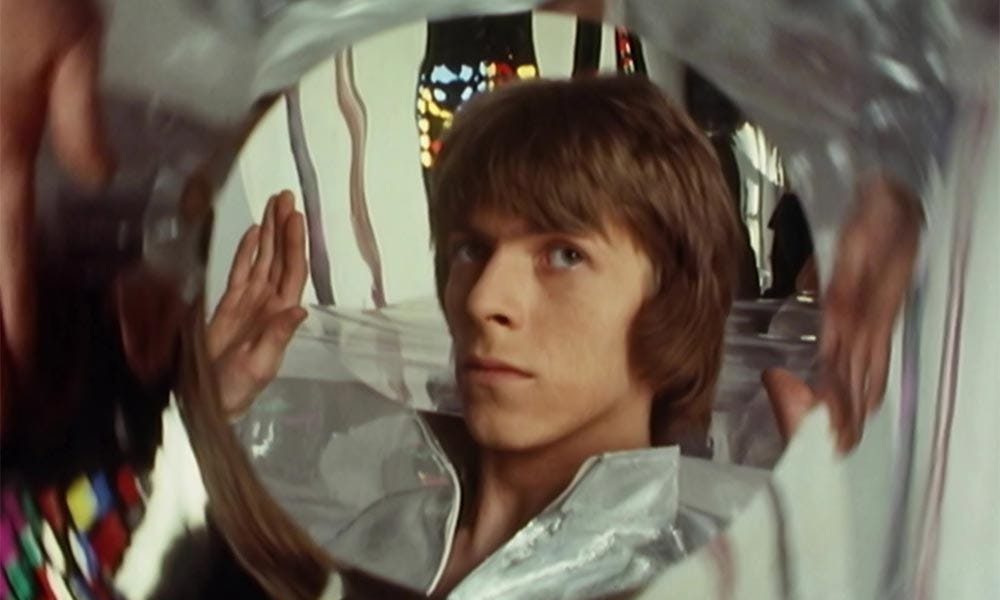
David Bowie as Major Tom in the first version of Space Oddity, 1969.

Ah 1969, the year that space themes were predominantly mainstream. David Bowie already recorded one previous version of Space Oddity, for his promotional film, Love You till Tuesday, but according to him, he was not very fond of that version to be included in his next album. "As I said, I recorded one song so far. But I really didn't like the finished song. Probably I'll record it again, but, like I said, there are a few more songs to record.", David Bowie - Press Conference - April 8th, 1969.

Since Tony Visconti seemed uninterested in re-record it again, delegating the producing process to Gus Dudgeon. The second version of Space Oddity was recorded on June 20th, 1969 at the Trident Studios, with the line-up consisting of keyboardist Rick Wakeman (then-session player), Mick Wayne, Herbie Flowers, and Terry Cox. The single was not played by the BBC until after the Apollo 11 crew had safely returned.

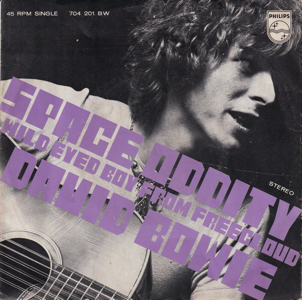
UK sleeve.

The single was released on 11 July 1969, backed by the Buddhist-influenced Wild Eyed Boy from Freecloud. After a slow start, Space Oddity became known as Bowie's solo breakthrough in the United Kingdom, topping in Britain, but being a minor hit in the United States at the time, reaching number 99. The song would be reissued a few more times until it reached number 15 in Billboard Hot 100 in 1972. The success rendered into Bowie's performance at the Tops of the Pops in October.

In the following times, in December 1969, Bowie recorded an Italian version of the song named Ragazzo solo, Ragazza sola, written by Mogol. Ten years later, Bowie would revisit Space Oddity in a stripped-down version released as single again. The song would renew its popularity after Canadian astronaut Chris Hadfield performed the song (with slightly revised lyrics) while aboard the International Space Station, therefore becoming the first music video shot in space.

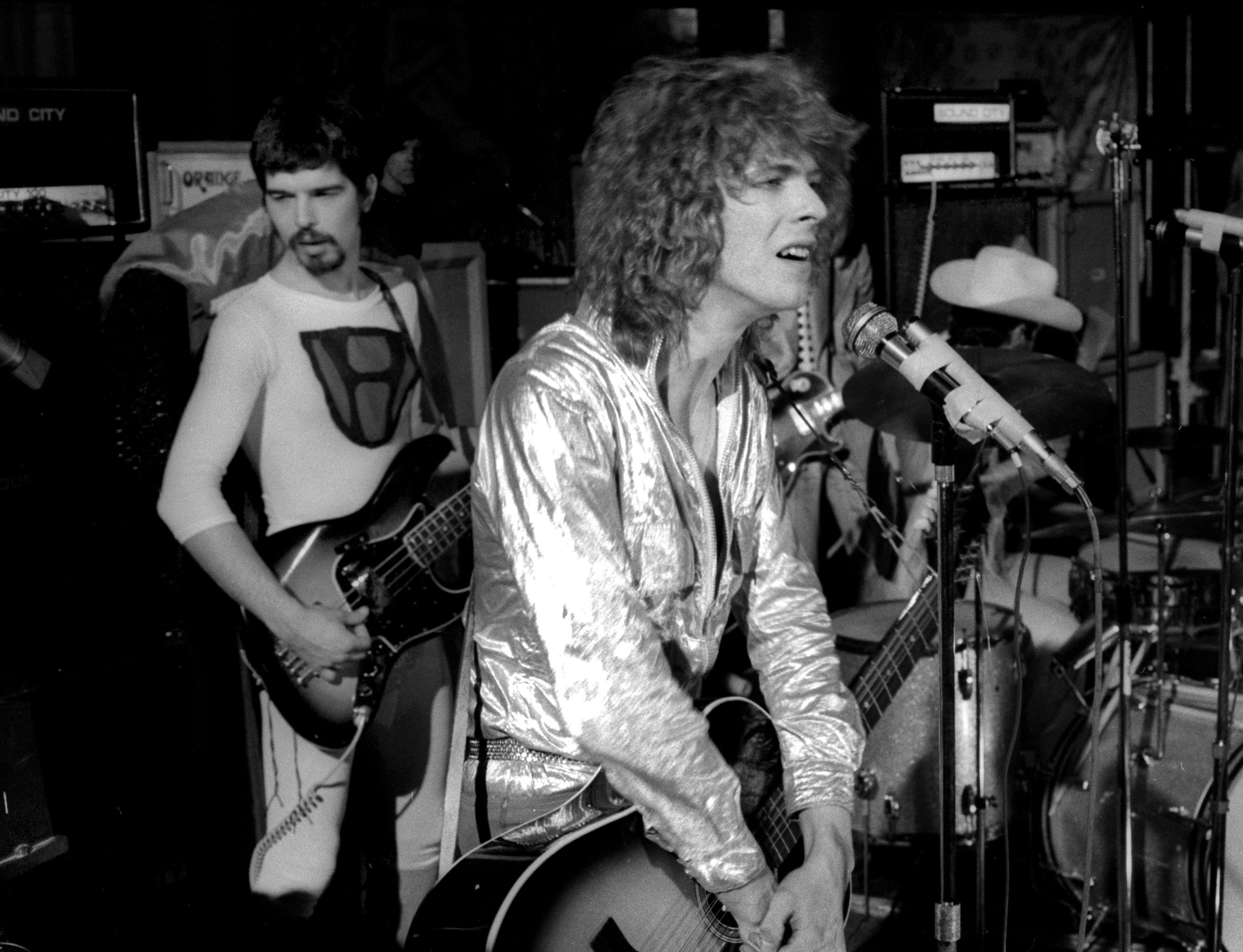
David Bowie performing with The Hype, at the Roundhouse, 1969.

Bowie started to record his second solo album around the same time as he recorded Space Oddity. Backed by a notable list of collaborators such as keyboard player Rick Wakeman and producer Tony Visconti, David opted to record at the Trident Studios instead of going to the United States this time. Regarding his status as a major growing artist from the underground scene, the deadline given by the heads of the Blackhill was until October, when David actually finished on time.
"It happened that in... August of that year, I believe, there was a reunion with the board [of directors], talking about the future stuff that we were doing and etc., but then Peter [Jenner] and my previous manager established a deadline to me to finish the sessions, without my consent. Obviously I was a bit angry with them, I didn't want to do something very rushed, but I played a little game with them, and I just finished exactly on October 31st."

 -David Bowie, 2001

The two first songs that were recorded to the album were Space Oddity, and the backing single, Wild Eyed Boy from Freecloud. Following both songs, the title track An Occasional Dream and Conversation Piece were subsequently recorded throughout August and September, since some of these pieces were written in-between late 1968 and early 1969. With brief interruptions, such as the Isle of Wight, and meetings within the people of the Blackhill, Bowie managed to safely finish the recording sessions in late October.

The last songs to be recorded were The Prettiest Star, a song that Bowie wrote to his newly-found partner Angela Barnett, featuring former Rubber Band bandmate and fellow friend Marc Bolan on electric guitar, The Supermen, a song that Bowie wrote inspired by the works of Friedrich Nietzsche and H. P. Lovecraft, which was added at the last minute, and Memory of a Free Festival because three versions of the song were recorded, two versions being included on the album as Part 1 and Part 2, and an alternate version which was then released as the backing single of The Prettiest Star.

With great anticipation, Blackhill Records announced David Bowie's second solo album, entitled An Occasional Dream. While in the United States the announcement almost went unnoticed, in Europe and the United Kingdom, the announcement of the album was received with a certain amount of hype towards Bowie's newest record. The Prettiest Star was released as the promotional single, backed by Memory of a Free Festival, becoming a hit and reaching the top 10 mostly due to the Space Oddity effect.

David Bowie – An Occasional Dream
David Bowie - An Occasional Dream (1969)
Genre: Progressive folk, psychedelic rock
Total: 44:33
All tracks are written by David Bowie.

Side A - 22:09
1. "Memory of a Free Festival (Part I)" - 2:43
2. "Space Oddity" - 5:16
3. "Unwashed and Somewhat Slightly Dazed" - 6:15
4. "Letter to Hermione" - 2:33
5. "God Knows I'm Good" - 3:21
6. "An Occasional Dream" - 3:01

Side B - 22:24
7. "Wild Eyed Boy from Freecloud" - 4:53
8. "Conversation Piece" - 3:05
9. "Janine" - 3:25
10. "The Prettiest Star" - 3:12
11. "The Supermen (Don't Sit Down)" - 4:18¹
12. "Memory of a Free Festival (Part II)" - 3:31

David Bowie's An Occasional Dream is the second album from the British singer-songwriter and mostly produced by Tony Visconti, except for Space Oddity and Wild Eyed Boy from Freecloud, which were produced by Gus Dudgeon. Along with the debut and previous album, Cygnet Committee, An Occasional Dream is considered part of the transition of psychedelic pop-influenced Bowie to his contact with Art and glam rock. The album was released on 17 December 1969 in the United Kingdom and 28 December 1969 in the United States.

It was noticed by the critics the evolution of Bowie's sound compared to Cygnet Committee, with the music being less influenced by the Rubber Band releases, and far more concentrated into a psychedelic folk sound noticed in Cygnet Committee's Lover to the Dawn, along with psychedelic rock influences of bands such as The Zombies, Bee Gees, and many other contemporary bands. Standouts of the record are generally given to its singles, Space Oddity, and The Prettiest Star.

Three singles from the album were released: Space Oddity, the most successful single, was initially released shortly after the recording sessions have begun, The Prettiest Star was released to promote the album, and The Supermen was released three months after the release, backed by an alternative version of Memory of a Free Festival. An Occasional Dream reached the British Top 10, and peaked in number 2, while it charted in Billboard 200 in number 96.

An Occasional Dream is regarded as one of Bowie's most refined records, and most mature record in the 1960s, even considering the albums from Rubber Band. Although the record received mixed to decent contemporary reviews, the album was reevaluated in more recent years, earning a large cult following along with Bowie's sixties-era, receiving enormous praise by many Folk and Indie artists.


Author's Comments:
And here we see The Beatles' path into the '70s, Pink Floyd on their peak in experimental music, and David Bowie's first hit as a solo artist.

Source:
The Beatles - Abbey Road
  • The Beatles - Abbey Road
  • The Beatles - The Beatles [White Album; Deluxe Version]
  • The Beatles - Yellow Submarine
  • Paul McCartney - McCartney I
Pink Floyd - Basking in the Sunshine of a Bygone Afternoon
  • Pink Floyd - Soundtrack of Film 'More'
  • Pink Floyd - Ummagumma
  • Pink Floyd - The Early Years 1965–1972
  • Pink Floyd - Zabriskie Point
  1. The Ummagumma is The Narrow Way - Part II
  2. Another Blues Number is Love Scene (Version 4)
  3. Rain in the Country is also known as Unknown Song
  4. Baby Blue Shuffle is The Narrow Way - Part I
  5. Rick's Piano Piece is Love Scene (Version 6) along with (Version 2)
David Bowie - An Occasional Dream
  • David Bowie - David Bowie (1969)
  • David Bowie - The Man Who Sold the World